


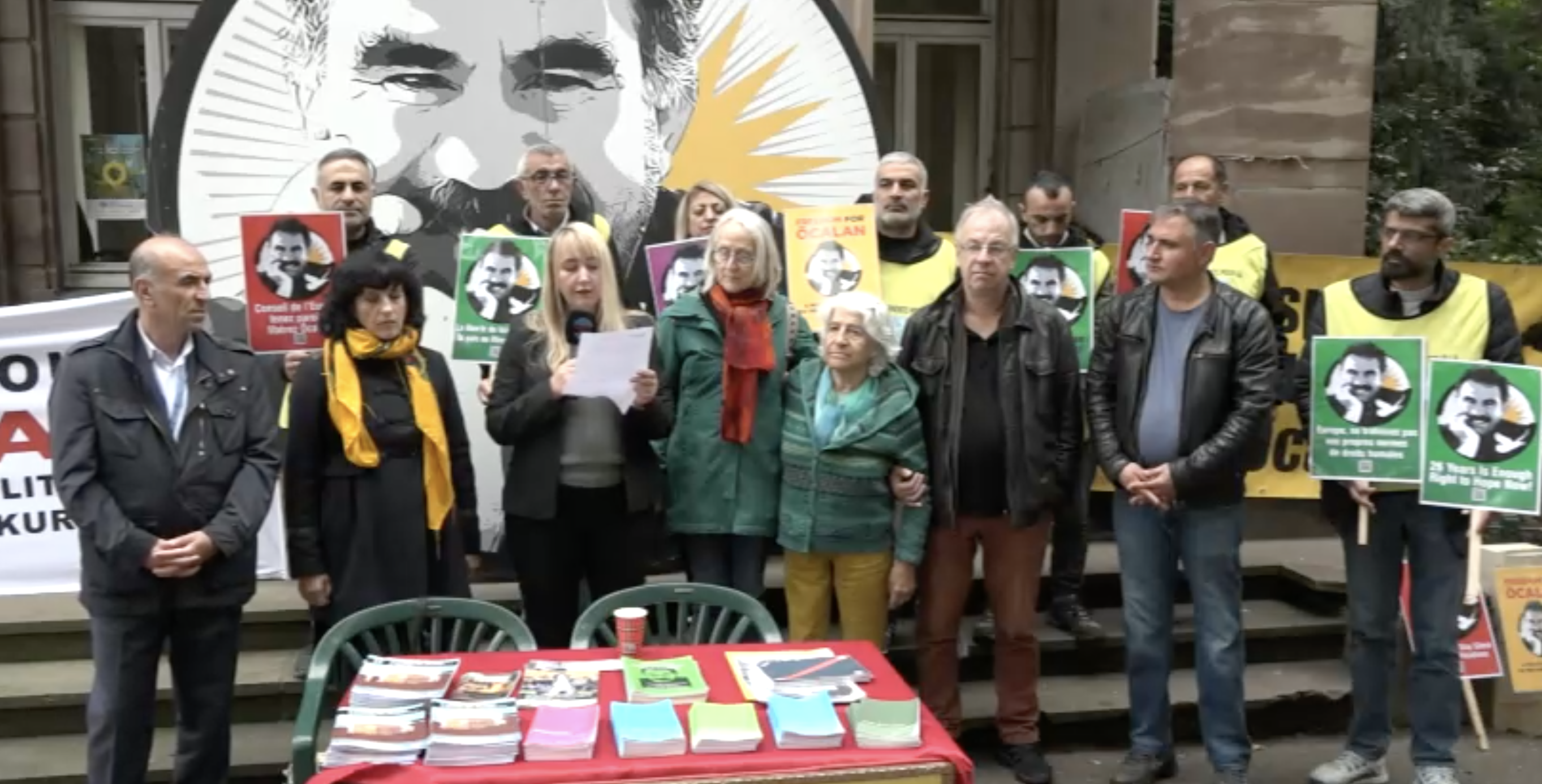
At the start of the autumn session of the Parliamentary Assembly of the Council of Europe, supporters of the international campaign “Freedom for Abdullah Öcalan – Political Solution to the Kurdish Question” called for increased political pressure on Turkey in Strasbourg. Politicians, doctors, scientists, and journalists spoke at a rally in front of the Council of Europe building on Tuesday. They demanded that the solitary confinement of Kurdish leader Abdullah Öcalan be ended and a peace process in Turkey be initiated in favor of a democratic solution to the Kurdish question. Among other things, the Council of Europe Assembly is discussing the human rights situation in Turkey this week.
“The right to hope is the key to peace”
Sinan Önal, political scientist and spokesperson at the press conference, recalled that the Committee of Ministers of the Council of Europe had already called for legal reforms in Turkey on several occasions—including in connection with the so-called “right to hope,” which the European Court of Human Rights (ECtHR) had confirmed in a landmark ruling in 2014. It states that life imprisonment without realistic prospects of release violates human dignity and the prohibition of torture.
“This right also applies to Abdullah Öcalan,” said Önal. Delegates from several countries held intensive talks with members of parliament in Strasbourg to exert pressure for legal changes.
“Ignoring or delaying peace is a crime against humanity”
Franziska Stier, secretary general of the left-wing, feminist, and ecological Swiss party BastA, said, “The right to hope is the key to lasting peace in Turkey. Öcalan has been isolated for almost 27 years, but his ideas have inspired millions. This is not just about an individual right, but about the collective hope of a people. Without hope, the Middle East remains trapped in suffering. The time has come to mobilize this collective hope and put an end to the suffering,” said Stier.
“Ignoring or delaying peace is a crime against humanity. The peace process initiated by Öcalan shows that change is possible. Since his call in February 2025, the ceasefire and the PKK’s decision to disband have created real hope. Millions of people, from Nobel laureates to civil society, are supporting this path alongside international institutions. However, the Turkish government is still hesitant. Despite calls for reform by the Council of Europe until 2026 and calls from the Party of European Socialists, Öcalan remains in isolation. Political prisoners continue to suffer. The Committee of Ministers has increased pressure, but more must be done. Think of the tears of families, the years of separation. Öcalan’s freedom is the key to a just peace, to a democratic society where everyone can breathe freely.”
Five demands on international politics
At the end of her speech, Stier formulated five key demands:
1. Turkey must implement the European Court’s 2014 ruling on the Right to Hope.
2. Political prisoners, including Abdullah Öcalan, must be released so that he can speak and move freely.
3. The Turkish Grand National Assembly must take real steps towards democracy and the recognition of Kurdish rights.
4. The EU, the US, and others should use diplomatic pressure (on the Turkish state) to stop military operations and remove the PKK from terrorist lists.
5. All segments of society—the opposition, civil society, women, young people—should participate in the process of building a democratic future.”
“We are no longer victims”
Other voices at the press conference came from the fields of medicine, media, and science. Ingrid Valbrach-Fickler, a specialist in psychiatry and psychotherapy and representative of International Physicians for the Prevention of Nuclear War (IPPNW), said, “I am here to support the campaign that aims for the freedom of the Kurdish people, for them to live their culture, to be free, and to be released from prison.”
In her speech, physiotherapist and IPPNW activist Dr. Nesmil Kasumlu, niece of PDK-I chairman Abdul Rahman Ghassemlou, who was assassinated in Vienna, Austria, in 1889, emphasized the central importance of the right to hope—especially for Abdullah Öcalan and the Kurdish people.
“We will no longer accept oppression. We are no longer victims. We can liberate ourselves; we are now represented in the political arena and capable of action. We can no longer wait for the world to help us—we must take the initiative ourselves.”
“Hope lives on—for now”
Belgian journalist Chris den Hond reported on the ongoing debates at the Parliamentary Assembly of the Council of Europe, stating: “We have participated in the debates, and we can say that almost all parliamentarians from different countries are aware of the problems Turkey faces because it does not meet the human rights standards of the Council of Europe. Many referred to the imprisonment of elected members of parliament, journalists and civil servants. Some emphasized the importance of Abdullah Öcalan’s call and Turkey’s positive response to this genuine call for peace. If Ankara and Damascus do not respond positively to Abdullah Öcalan and the PKK’s call for progress toward peaceful coexistence among peoples, the situation could be quite the opposite. In other words, there are not many options left. However, the hope for peace remains open and will progress in the coming months. Pressure on Turkey from international organizations such as the Council of Europe is increasing. We hope Turkey responds positively to this increasing pressure.”
“We need to keep up the pressure”
British scientist Dr. Sarah Glynn referred to the criticism of Turkey in the PACE debates and pointed out that they had received a great deal of support: “After watching and listening to the debate at the Council of Europe, it was very striking that Turkey received condemnation from across the political spectrum. I think the only exceptions were the AKP speakers who read their own statements and an ultra-right-wing man who was more interested in what was happening in Germany than in Turkey. So, there is support. There is very strong support. However, we need to keep up the pressure to turn this support into action.”
“The Council of Europe must act”
Faruk Yağızay, the DEM Party Representative in Strasbourg, said: “Turkey has been an important member of the Council of Europe since its establishment. It has signed many agreements and committed to complying with them. There has been a war going on for more than 40 years. And now, at the call of Mr. Öcalan, this war has ceased. What’s more, the PKK has dissolved itself and has begun the process of destroying its weapons, albeit symbolically. And there are things Turkey needs to do right now. Yes, a commission has been established. Unfortunately, however, Turkey has not taken any concrete steps in response to the steps taken by the PKK. Our friends who believe that Turkey, as a member of the Council of Europe, must fulfill its responsibilities are here to ask the Council of Europe to urge Turkey, as its own member, to act in accordance with the Council’s standards. We believe that the Council of Europe should pressure Turkey to act in accordance with its own standards and encourage it to do so.”