


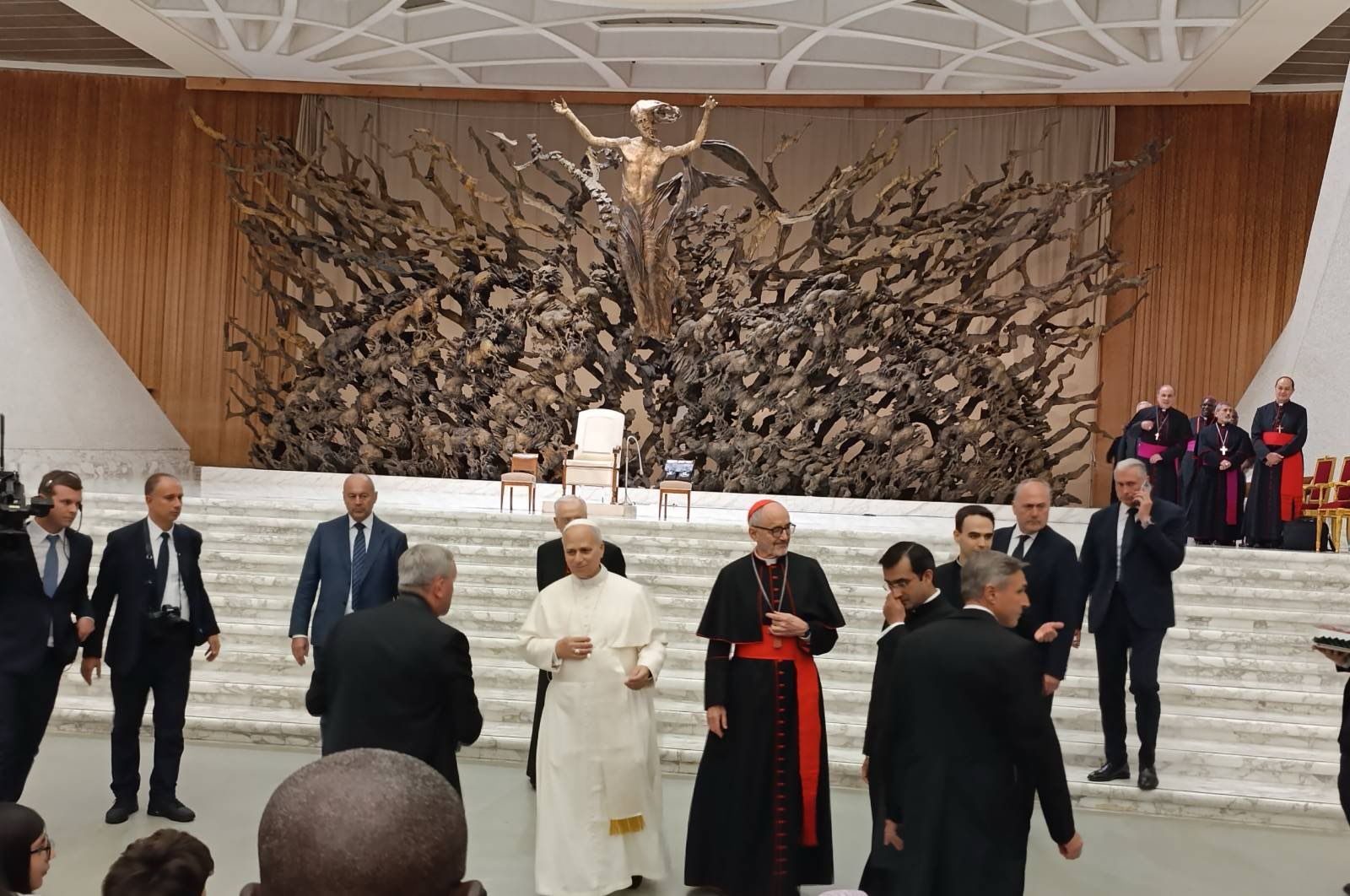
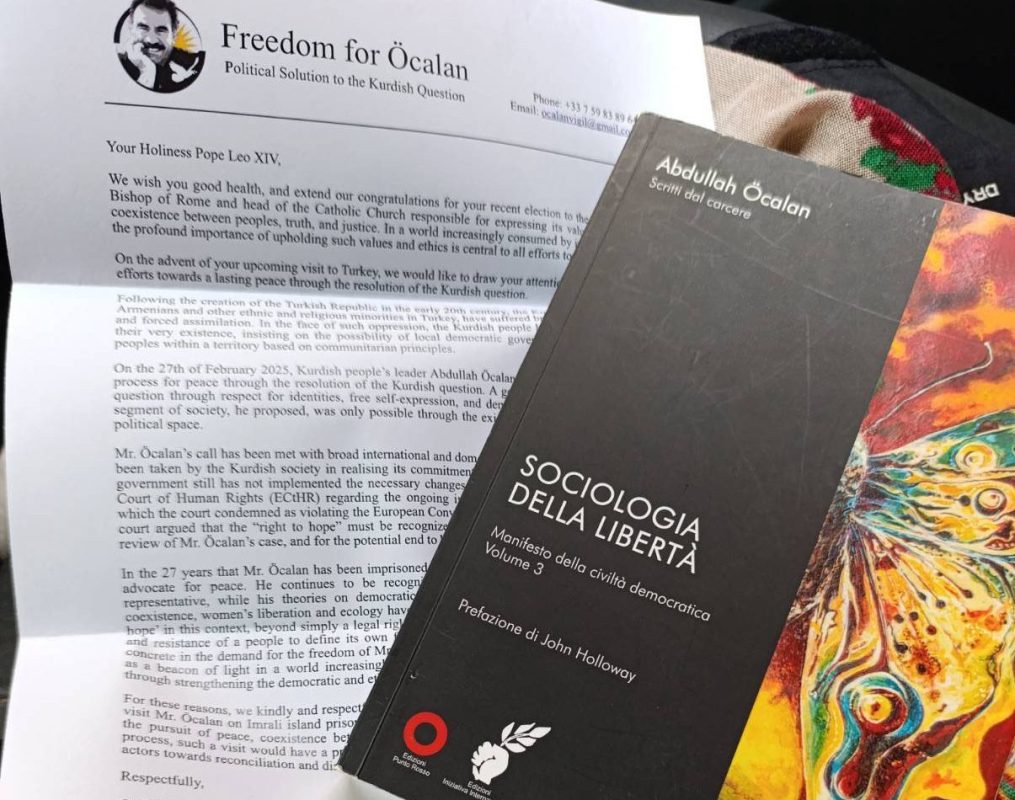
Yesterday, the 23rd of October 2025, a delegation held audience with the Pope of the Catholic Church, Leo XIV. The delegation delivered a letter to the Pope, highlighting the importance of the ongoing process for “Peace and Democratic Society”, and the freedom of Kurdish peoples leader Abdullah Öcalan. They also gave the Pope a copy of one of Öcalan’s books, the Sociology of Freedom, outlining the new paradigm of democratic confederalism.
One month from now, Pope Leo XIV will visit Turkey at the invitation of local religious and political leaders to celebrate the 1,700th anniversary of the Ecumenical Council of Nicaea with a pilgrimage to the city now known as İznik. Only last week, the Pope canonised—recognized as a saint—Ignatius Maloyan, the Armenian Catholic Bishop of Mardin who was martyred on the orders of the Committee of Union and Progress (CUP) in 1915 in Amed (Diyarbakir), North Kurdistan. He is remembered for his humanity, dedication to the Armenian people, and fostering a spirit of co-existence between peoples of the region. The decision to formally recognise Ignatius Maloyan as a saint shortly before a trip to Turkey sends a clear message: one of support to resisting peoples of the region, and against the genocidal policies of nation states. The Vatican’s official statement further reads:
“Then as now, in our troubled world, self-interested nation-states rarely placed moral imperatives, human rights, or the defence of life and liberty above fleeting norms that brought disgrace rather than honour to humanity.”
In the letter delivered to Pope Leo XIV, campaign organisers highlighted the crucial work of Abdullah Öcalan in developing a philosophy of multi-religious and multi-ethnic coexistence, democratic self-governance women’s liberation and ecology that has inspired movements around the world. They invited the Pope to visit Mr. Öcalan, as a concrete way to support the ongoing process for “Peace and Democratic Society”, and a political solution to the Kurdish question. The letter reads:
On the advent of your upcoming visit to Turkey, we would like to draw your attention to crucial ongoing efforts towards a lasting peace through the resolution of the Kurdish question.
Following the creation of the Turkish Republic in the early 20th century, the Kurdish people, as well as Armenians and other ethnic and religious minorities in Turkey, have suffered brutal policies of genocide and forced assimilation. In the face of such oppression, the Kurdish people have waged a struggle for their very existence, insisting on the possibility of local democratic governance, and coexistence of peoples within a territory based on communitarian principles.
On the 27th of February 2025, Kurdish people’s leader Abdullah Öcalan opened the way for a renewed process for peace through the resolution of the Kurdish question. A genuine resolution to the Kurdish question through respect for identities, free self-expression, and democratic self-organization of each segment of society, he proposed, was only possible through the existence of a democratic society and political space.
Mr. Öcalan’s call has been met with broad international and domestic support, and significant steps have been taken by the Kurdish society in realising its commitments to this process. However, the Turkish government still has not implemented the necessary changes: among them decisions by the European Court of Human Rights (ECtHR) regarding the ongoing imprisonment and isolation of Mr. Öcalan, which the court condemned as violating the European Convention on Human Rights. Most crucially, the court argued that the “right to hope” must be recognized by Turkey—that is, the possibility for the review of Mr. Öcalan’s case, and for the potential end to his imprisonment.
In the 27 years that Mr. Öcalan has been imprisoned, he has used every opportunity at his disposal to advocate for peace. He continues to be recognized by millions of Kurds as their leader and representative, while his theories on democratic self-governance, multi-religious and multi-ethnic coexistence, women’s liberation and ecology have inspired movements around the world. The ‘right to hope’ in this context, beyond simply a legal right in an individual case, can be understood as the hope and resistance of a people to define its own future, free from war and oppression. This hope, made concrete in the demand for the freedom of Mr. Öcalan and the ongoing peace process in Turkey, shines as a beacon of light in a world increasingly consumed by conflict, illuminating the way for peace through strengthening the democratic and ethnical nature of societies.
For these reasons, we kindly and respectfully ask for your support on this crucial matter, and for you to visit Mr. Öcalan on Imrali island prison. Such a visit we believe would demonstrate a commitment to the pursuit of peace, coexistence between peoples, and justice. With regards to the ongoing peace process, such a visit would have a profoundly positive impact, opening the way for further steps by all actors towards reconciliation and dialogue.