


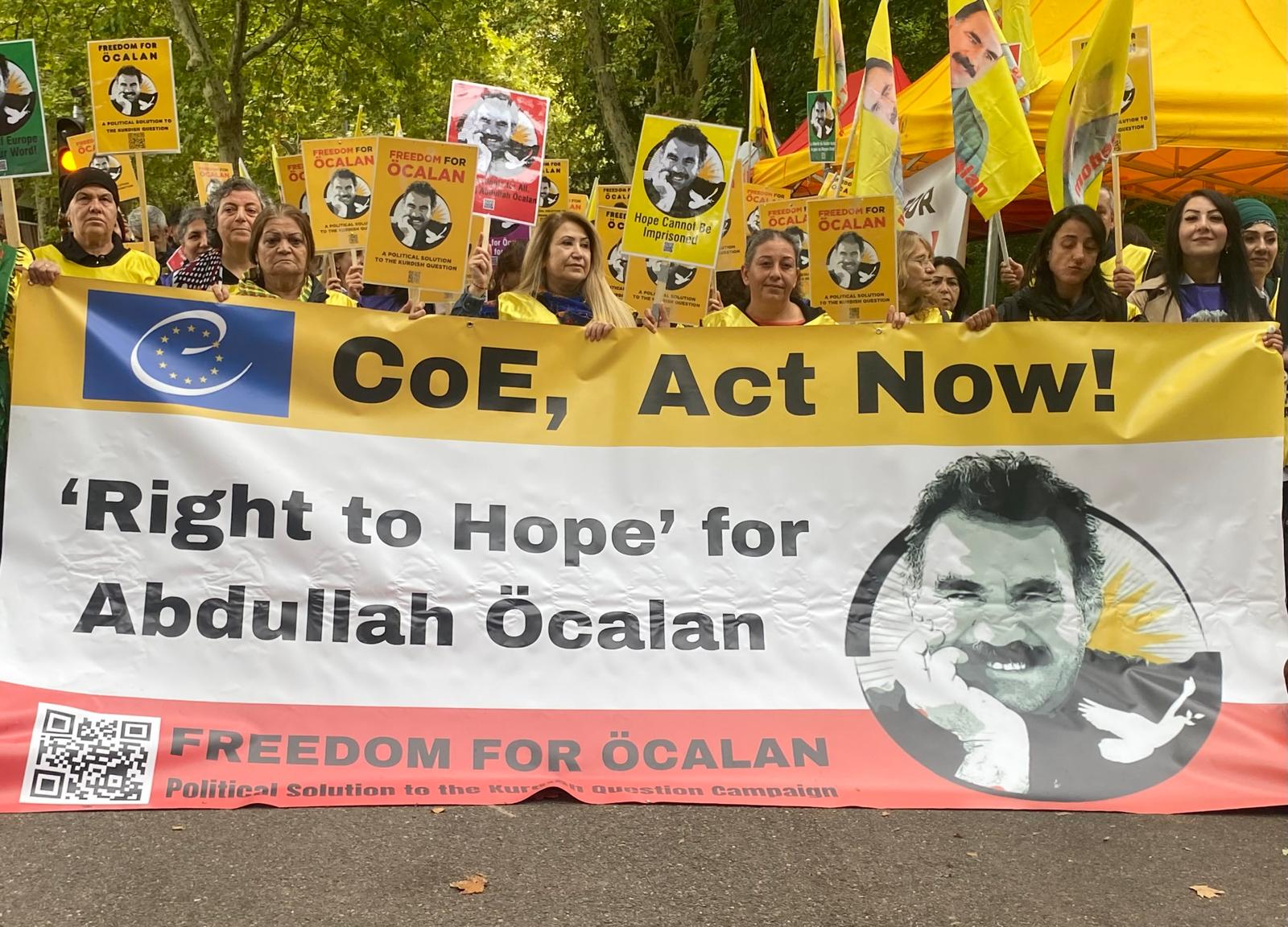
On the 17th of September, the Committee of Ministers of the Council of Europe announced an interim resolution to be taken against Turkey, in light of the failure to implement ECtHR decisions related to the case of Abdullah Öcalan (Öcalan v Turkey (2) 2014) and others in the Gurban Group charged with “aggravated life imprisonment.” This comes after the Committee in its 2024 meeting had already given Turkey a deadline of one year to implement the necessary changes in law—a deadline that Turkey did not respect.
The Committee of Ministers exhorted the Turkish authorities to take the necessary measures without further delay, giving them until June 2026 at the latest to provide information on the measures taken to ensure the implementation of the ECtHR decisions. In the interim resolution the Council of Ministers recognises the new “National Solidarity, Brotherhood and Democracy Commission,” established in the context of the ongoing process proposed by the Kurdish People’s Leader Abdullah Öcalan for ‘Peace and Democratic Society’ as having the mandate to propose legislative amendments to Parliament, and a potential mechanism for proposing and implementing the needed changes in law to recognise the “Right to Hope.”
The approach of the Committee, itself a political body, reflects an understanding of the recent changes in conditions on Imrali, the new process for ‘Peace and Democratic Society’, and initiatives put forward by Mr. Öcalan such as the new commission in the Turkish Parliament. However, it fails to recognise directly that the Kurdish society, with Mr. Öcalan as its key representative and interlocutor, have been the driving force behind all positive steps made in this process. As the interim measure relate to political processes, they must also equally consider the crucial role and work of Mr. Öcalan on building peace and democracy, and counterpart to the Turkish state in this process. Recognising his role is indispensable for any sustainable mechanism that links legal compliance with political dialogue.
We understand the goodwill of the the Committee in referring to the parliamentary commission in Turkey. However, we are in a transitional period: until now, neither the Turkish government, nor the commission, has made any legal changes towards the abolition of ‘aggravated life imprisonment’ or a greater respect for human rights and law. In this light, on what grounds does the Committee assess that Turkey is able to make the needed changes? The internal dynamics of the Turkish government are not sufficient to make the necessary transformation, and in this sense the Committee of Ministers and Council of Europe must use the enforcement mechanisms at its disposal to ensure Turkey implements the decisions of the ECtHR. Further, use of the “Terror-Free Turkey” narrative should be criticised in that it prioritises a nationalist approach, counterproductive to a process of democratisation.
We welcome the fact that the Committee of Ministers have for the first time implemented an interim resolution for the case of Mr. Öcalan, and others represented in the Gurban Group. It is crucial, however, that the Committee does not wait until June of 2026 to take its next steps. The central political role of Mr. Öcalan as the key interlocutor and representative of the Kurdish people must be recognized. Offering Turkey time until June 2026 means allowing Turkey to continue with ongoing violations.
In practical terms, the Committee should consider dispatching a delegation to Turkey to observe the situation directly, engage with parliamentary commissions, and report on the government’s willingness to move beyond declaratory commitments. An ad hoc committee should be created to specifically follow the developments in Mr. Öcalan’s case and the implementation of the “Right to Hope”. Peace and democracy in Turkey can only be achieved the resolution of the Kurdish question. As the key interlocutor in the peace process and internationally recognised representative of the Kurdish people, Mr. Öcalan’s freedom is necessary for the success of the process.